Inconsistent Metric Definitions
The same metric can mean different things across teams and systems, causing BI reports and AI answers to conflict.
MetaAGI compiles metrics, rules, processes, and experience from documents and systems into machine-readable ontology. AI Q&A, business diagnosis, and merchandise strategy can share one business language with traceable answers designed to minimize hallucinations.
Trace: metric source dws_store_month, scope = monthly store sell-through.
Trace: rule source Mid-season Merchandise SOP, Chapter 3; actions = transfer/promotion/delist.
The diagnosis includes field-level traceability and recommended actions.
Execution results can flow back to continuously update enterprise semantic memory.
Translate scattered data, documents, and experience into reusable business semantics that AI can understand and execute.
The same metric can mean different things across teams and systems, causing BI reports and AI answers to conflict.
Operating knowledge is locked in Word, Excel, and PPT files, making it hard to find, understand, align, or transfer.
General-purpose LLMs lack enterprise context, so they may hallucinate, miss traceability, and fail decision-grade trust.
Each AI app redefines products, stores, and metrics. One business-definition change must be synchronized repeatedly.
A complete loop for ontology parsing, semantic mapping, intelligent Q&A, and knowledge governance.
Multi-agent pipelines decompose metrics, rules, processes, and business objects automatically.
Turn knowledge scattered across documents and experience into manageable, publishable ontology assets.
Describe business semantics through eight standard enterprise elements.
Unify objects, attributes, relationships, value types, metrics, rules, actions, and security.
Map business terms deterministically to physical tables, fields, and data models.
Let LLMs query through published mapping paths instead of guessing tables or drifting definitions.
Extract semantic elements from metrics, SOPs, and operating reports.
Route questions to knowledge bases and warehouses by intent, then return trusted answers with traceability.
Democratize business semantics for better decisions.
Use one enterprise ontology to define products, stores, members, metrics, rules, and actions across departments.
Structure operating knowledge so it survives employee turnover, can be reused across teams, and can be adapted to new industries through a shared semantic foundation.
Provide traceable answers grounded in published ontologies, mappings, and knowledge bases, designed to minimize hallucinations.
Let Q&A, diagnosis, and merchandise strategy share one semantic foundation instead of rebuilding definitions per app.
Connect applications, knowledge assets, and data foundations through enterprise ontology.
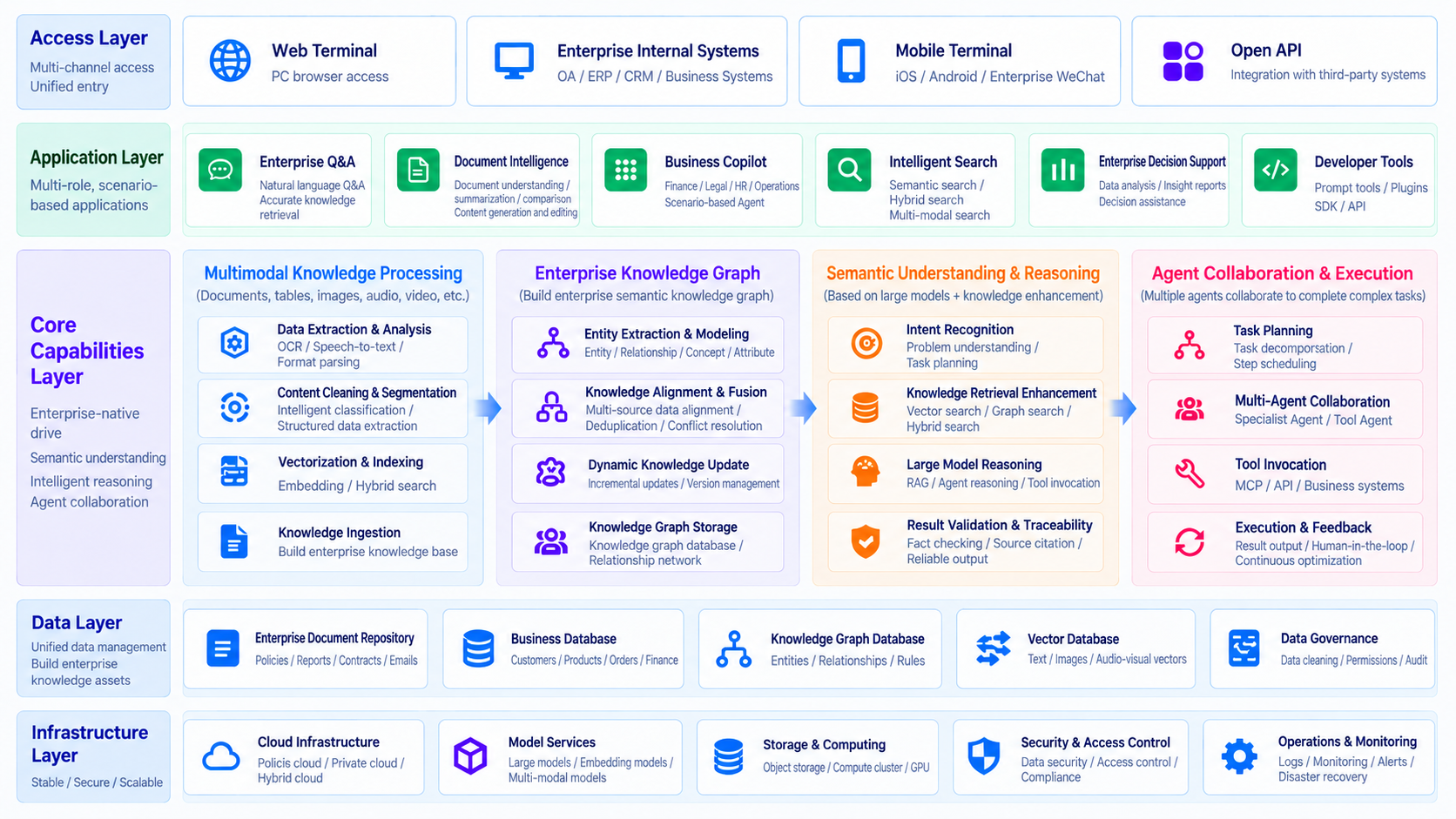
The ontology modeling center provides one semantic foundation for intelligent Q&A, Store Intelligence, Omnichannel Allocation, and other upper-layer applications.
Visual modeling and versioning for objects, attributes, relationships, and value types with AI extraction and human curation.
Define metric scope, formulas, dimensions, periods, and business rules consistently across systems.
Manage synonyms, aliases, history, and source traceability so concepts stay aligned.
Map objects, attributes, metrics, relationships, rules, and actions to physical tables and fields.
Upload metrics, SOPs, and reports, then let AI extract ontology candidates and mappings.
Use knowledge access, data permissions, audits, and rollback to govern assets safely.
Ontology breakdown, semantic mapping, and governance ensure trusted business understanding.
Multi-agent pipelines handle parsing, disambiguation, confidence scoring, completeness checks, and human review.
Map ontology objects, metrics, rules, and relationships to warehouse fields for deterministic data routing.
Protect semantic assets through data permissions, knowledge access, audits, and version rollback.
Lower the barrier to business semantics for headquarters, merchandise, store, and data teams.